24 Feb 2007

Medieval Islamic Mosaics Used Modern Math

This weeks 'scientists labouring under assumptions of superiority' story comes to us courtesy of live science.com

The inlaid patterned tiles grace the walls of many structures worldwide, in patterns of mind-boggling intricacy called "girih." Historians have always assumed that medieval architects meticulously developed the patterns with basic tools....

Most mosaic tile walls in medieval Islamic buildings are based on a polygon and star pattern, with lines atop them creating a zip-zag look [image]. Since polygons don't fit together properly without near-perfect symmetry, it would have been very challenging to make the patterns look right, historians say, but they assumed a basic straight-edge and compass were used to get the job done.

Ok, look again at those dazzling tile murals and imagine some potter struggling away with ruler and compass. Not a convincing argument to start with. Why are scholars surprised to find what seems to amount to a 13th Century pattern book being used across the region? It would be nice to read something about ancient ceramics in the press, just the once, that didn't demonstrate how removed from the process of making the 'experts' have become.

Cobalt, the mineral usually used for the blue in glazes in ceramics is pretty tricky to work with, a little goes a really long way, and only when it's fired does it look blue. Now if they were to find the test tiles and the glaze recipes that were also probably doing the rounds with the patterns...
that would be wonderful, but they are probably not looking for that...

17 Feb 2007

ok, just one more manifesto....

just for fun.


Dada. I heard about the dada manifesto when I studied Art History in school, but we only saw slides of it, here is a translation. Hey, it makes more sense than this ever did.

a sucker for a manifesto

manifesto
1644, from It. manifesto "public declaration explaining past actions and announcing the motive for forthcoming ones," originally "proof," from L. manifestus (see manifest).

I found this manifesto strangely appealing. Nothing to do with me being a typography whore... obviously.

16 Feb 2007

why make stuff?

Heather put me onto this manifesto by Mark Boyd that showed up on Gapingvoid.

You can change the world with a pencil, a piece of paper, a chunk of
charcoal and piece of cardboard, a paintbrush, a crayon, a d-cam, a
blog, a cell phone, a recorder; a projector, some clay and a kiln, some
wood and a few tools, some sticks, stones, and grasses, a stove and
some vegetables, found glass, paper, metal, plastic, a torch, a welder,
a stick and some sand, a knife to carve with, an idea, some mud and
hay, a computer, some seeds, a needle and thread and scrap of fabric,
the list goes on. You can change yourself by using any of this stuff or
any thing else that might come to mind and hand.

Why we make stuff matters. How we make stuff is secondary. Any method,
material or vehicle that allows you to get to what you're trying to
see/feel/say/suggest is equally valid. What we make is not the point.
That we make, that we DO, is.

Making stuff develops the ability to see, hear, taste, smell and feel.
Making stuff is about problem solving, the openness to possibilities,
development of skills, internal and external navigation and resolution,
a sense of exploration and adventure. Making stuff transforms one from
a consumer to a contributor. Making stuff is not passive. Making stuff
involves making choices. Realizing you have choices and making them is
empowering. Empowerment leads to confidence, and the courage to
question and challenge the status quo. Making stuff and sharing it is a
social and political act, which opens avenues for communication. That
can help prevent us from becoming mindless drones subservient to the
mass media, politicians, advertisers and commercial interests that have
constructed the consumer culture for the purposes of distracting and
desensitizing us from reality.

Make it up, make do, make it real, make it personal, make it public.
Make it work, make it accessible, make it cheap, make it fun, make it
serious. Make it loud or soft, make it bright or dim, make it big or
small. Make it obvious, make it subtle, make it to be touched, tasted,
smelled, heard. Make it open to interpretation, open for discussion,
open to criticism. Make it open. Make it from found stuff, made stuff,
recycled, reused and repaired stuff. Make it from scratch, from a kit,
a mix, a box. Make it new or make it old. Make it specific, make it
general, make it purposeful, make it pointless. Make it a question,
make it an answer, make it clear, make it vague. Make it high tech,
make it lo-fi, make it inclusive.

Just make it. When you're done, make more and make different. No need
to explain, justify, apologize, or validate. Make it, and let it go.

Dare to fail big, and attempt to change the world. Resist conformity,
think for yourself and go make some stuff of your very own.

us/ing technology

29 Jan 2007

if not the actual teapot that killed Litvinenko...

It is allegedly a remarkably similar one.

dopa ii

It looks like that whacky Senator Ted Stevens is at it again, if it ain't tubes it's something else...

There are laws, and there are hasty-rushed-and-bad-laws (Any legislation that gets brought in on the back of "this week's moral panic". Any son of DOPA is liable to fall into the latter category.

27 Jan 2007

nice dektop?

I saw this and my initial reaction was 'wow!' yet as the film wore on I just kind of thought about the stack of A4 documents that I had rattling around in piles in work and at home... it just made me long for a proper table that I could shuffle real papers around on rather than some tiny Toshiba M200 screen. Happily, I have a fine tale to shuffle on...

feeling 'russian'


Shortly before Christmas, a new Tesco's opened in Carmarthen. It is allegedly the largest Tesco in West Wales... I hate it. I used to hate the huge one in Swansea, but this one really bites. What I hate about it most is the inhuman scale of the place, the only way I can describe it is to borrow a word from Watership Down - Tharn.

The first time I remember going tharn in a supermarket is the first time I visited the Safeway near B's old place in Portland. I stood in front of a dizzying array of 'hamburger helper' which seemed to stretch off as far as my eyes could see. What the hell was 'hamburger helper' and why did it need a whole aisle?

Anyway, this picture took me right back to that day in Portland.

If you are wondering why we shopping has become such an ordeal of endless choices, Malcolm Gadwell's Ted Talk might give you some insight as to why there are so many spaghetti sauces in the next aisle to all the hamburger helpers.

14 Jan 2007

new blog, new year, new resolve

I have started a new blog here. Last March I started blogging some ideas that I had for improving the ICT confidence of primary school teachers in the county where I work. I have spoken to quite a few people about it within the council, but it's now clear that no one is going to pick up on anything as cross cutting as this with the current structures and mindsets.

Last week, I finally got around to contacting Business Eye, who have put me in touch with Venture Wales so that we can look at seeing if we can make a bit of money marketing Welsh companies to a very targeted, mostly American audience and Co-op Wales who they think might help me get the proposal off the ground in some sort of form. Fingers crossed.

11 Jan 2007

I found this on we make money not art today and thought it a fine piece of art.

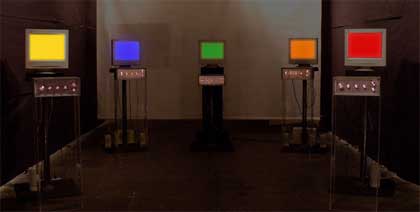
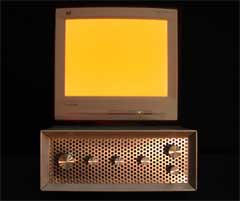
Instead of presenting complex images (computer programs or photographs) each computer of The Analog Color Field Computer (ACFC) repurposes its monitor such that a solid field of color is spread across its entire display. And instead of producing complex sounds (clicks, beeps or music) each sculpture produces a pure musical tone.

By minimizing the content of its audio-visual renderings to solid colors and pure tones, the device offers relief from the myriad of visual, sonic and operational conventions traditionally associated with computer systems. The audience can adjust the hues, pitches and rhythms of each computer and thus assume a role previously reserved for a computer's video processor. They can manually regulate the electrical currents that command the monitor's color circuitry. The ACFC does not employ display systems as media for the visualization of computed images, instead the aesthetic artifact is derived from the physical manifestations and electrical workings of computer monitors themselves.

The piece also points to the rate at which Cathode Ray Tube based monitors are being discarded to leave the space to the much leaner flat panel displays. The ACFC gives the screens a new life as pieces of art. As a tribute to the CRT century-old technology, the installation utilizes analog electronics almost exclusively.


6 Jan 2007

seasonal readings

As you may have noticed, there was a not much posting activity here during December. Two reasons for that, firstly I was pretty low energy, the combination of B's illness, the usual unseasonal bah-humbuggery, and a generalized irritation with aspects of my work-life balance. Secondly, I've been in a bit of a reading phase. The consequence of this is that instead of having nothing to blog, I've had too much, and I haven't known what to pick.

So, I want to tell you about 3 of the books that I have been reading over the last 3 weeks.

  1. Phillip Reeve, Mortal Engines. (I picked this up in a school library while I waited for an engineer to call me back. By the time he called back I was on chapter 4 and totally sucked in. I just had to buy it then. If you liked the Phillip Pullman, "His dark materials" trilogy, you might like this. Pretty gory for the age group it was designed for though.
  2. Sally Hacker, Doing it the Hard Way. One of my presents off B. It was a book that I used extensively in my MA dissertation and really wanted to read again.
  3. Moira Vincentelli, Women Potters. Great book, it examines women's pottery that has been pretty much ignored on a global basis. We are not talking about the fancy thrown and glazed stuff here, we are talking about hand built and bonfired. It also features interesting insights as to why a lot of the 'development' projects in pottery fail as well as a chapter on women's figurative ceramics.
Rather than review them, I'll give you a taster of the three of them. So, in order...

"Never forget, Apprentices, that we Historians are the most important Guild in our city.We don't make as much money as the Merchants, but we create knowledge, which is worth a great deal more. We may not be responsible for steering London, like the Navigators, but where would the Navigators be if we hadn't preserved the ancient maps and charts? And as for the Guild of Engineers, just remember that every machine they have ever developed is based on some fragment of Old-Tech - ancient high technology that our museum keepers have perserved or our archaeologists have dug up."

"Bureaucratic organizations make responsible behaviour difficult. They tend to foster a "who cares?" attitude at lower levels of the organization and a "not me" attitude at the top (Gouldner 1976: Garson 1977). Those who chose engineering as a profession are likely to work in large bureaucratic organizations, but are less likely than most to have an interest in social structure or the complexities of social relations (Rossi 1975). Further, engineering education does little to increase students awareness of these phenomena. And so the engineer is oblivious to the ways in which he or she both affects and is affected by patterns and relations on the job.
If engineers do have a "blind spot" about social structure, altering current patterns and finding alternatives will be most difficult"

"As with all new technology, the introduction of water filters has to be accompanied by an education programme to ensure people understood how to use and maintain them properly.
There is a good argument for suggesting that it is more viable to build on the skills that are already in the community rather than seek radical change. It is particularly dangerous to make people dependent on technology that they cannot themselves produce, control or maintain. Self sufficiency is often assumed to be the aim but in fact projects can create dependency when equipment fails or followup expertise is not there."

Are we noticing any themes emerging?

dead as a DOPA

Good news, DOPA looks like it's died a death. ZD Net has coverage of the story here.

On the topic of Web 2.0 and education, a belated congrats to Miles Berry, who was awarded the Teacher: Primary award from BECTA this year. I regularly read his blog in Elgg and think he is doing a bang up job of using ICT creatively in his school and is a great advocate of Open Source software.

3 Dec 2006

cray-ola

I'm fairly partial to the odd bit of wood carving, but I am in awe of these crayons. Utterly pointless but just yummy.

1 Dec 2006

are we doomed?


I want to confess something. It's my shameful secret.

Sometimes play in first person shooters.
When I'm not playing first person shooters, I'm a pacifist and a feminist.

I used to try and justify it but ('We can't help being shaped by the society in which we live', as the Socialist Workers in College used to say,) now I just realise that we are all walking bundles of contradictions, like an ex of mine who when she wasn't busy being an anarcho-feminist poet had a strange but deep fondness for James Bond movies.

That said, I think the idea of this HalfLife 2 mod is pretty interesting. I found myself reeling off fun facts about alpha radiation to Zach in the car yesterday and realised that I picked them up from the screenshots of this mod.

Now I am almost at the point of wanting to borrow a copy of Halflife 2 just so that I can play the Mod. The problem that I had with single player Halflife was that battling monsters wasn't really engaging enough to drag me fully out of real life (Multiplayer Halflife had a different problem, Zach just kept slaughtering me...)

26 Nov 2006

doing our bit?


Your dog wants you to switch the lights out when you have finished in there.

Check out these rather nice ads from this French energy company.

UI on the OLPC


This is a demo of the user interface that is set to go out on the $100 laptop.

25 Nov 2006

theories and methods

I came across a couple of interesting pieces over the last couple of weeks that I thought I would share. The first thing is the What's In a Number 2006 Edition (320) of This American Life.

"Recently, the British medical journal The Lancet published an study which updated their estimate of the number of Iraqis who've died since the U.S. invasion. With that in mind, we revisit a show we did in 2005 about the earlier study published in Lancet estimating the number of Iraqi deaths. That study was mostly ignored in the U.S. Alex Blumberg revisits the original study and looks at the new one."

Good research, unpalatable results.

Now for bad research and really unpalatable results.

Navajo's have been getting sick for decades, and their sheep have also been getting sick but instead of looking at what the people and sheep might have in common, for years the medical researchers declared it to be a condition which they called "Navajo neuropathy". If they had been less blinkered in their approach they might have discovered eariler that the people and anmals were drinking uranium contaminated water from holes left by uranium mining in the 1950s.

You can read all about it here.

oh yeah, science 'solves' ceramic mystery...

Nice set of Hessian crucibles.
Was it me or does anyone else find the RSC article a bit patronising when it says:

"Successful Hessian manufacturers of the time were cheerfully unaware of the science behind their internationally renowned mixing vessels."

"Cheerfully unaware"? WTF?

23 Nov 2006

how stuff gets made


I'm a sucker for seeing how things get made, so I have been picking my way through this site. It's irritatingly 'gee-whizzy' and at times, but that's not really surprising seeing as it is comming from the National Association of Manufacturers in America, but if you can overlook that, there is lots of good stuff. How they make duct tape ("I got chills") has to be regarded as a classic of it's genre. You will love it, inspite of yourself. Can't you feel the manufacturing vibe?